

What if the biggest investment you make this year ends up as a digital white elephant that employees actively avoid? It is an uncomfortable thought, but for many businesses this is the reality when the purchase of an LMS system is driven purely by technical specifications rather than the users' actual needs. In 2026, the rules are stricter than before. With the EU AI Act in full force and new guidance from the Norwegian Data Protection Authority regarding safer digital learning, it is easy to feel that the technical and legal requirements overshadow the actual goal: good training.
We completely agree that it is challenging to compare suppliers when everyone promises the same thing, but has different pricing models and integration options. You want a solution that works seamlessly, ensures privacy and is actually used. In this guide, you will learn how to choose a system that creates genuine enthusiasm for learning and value for the organisation. We provide you with a clear checklist to help you prioritise correctly, ensuring you end up with efficient course administration and a reliable British partner on your team who understands local needs.
Important points
- Learn why digital skills development is a critical competitive advantage in 2026 and how to avoid costly misinvestments.
- Discover methods for mapping the needs of employees, managers and administrators to ensure high usability and enjoyment of learning.
- Get a complete overview of the technical requirements for security, integrations and GDPR that are crucial for the safe procurement of an LMS system.
- See how to put together the ideal project team to ensure a structured and efficient procurement process from start to finish.
- Understand the benefits of a Norwegian partner that combines powerful functionality with deep knowledge of local privacy requirements.
Why is the process surrounding the procurement of an LMS system so critical?
In 2026, knowledge is the company's most important currency. The pace of working life is increasing, and the ability to quickly train employees in new tools or regulations determines who wins market share. A well-considered procurement of an LMS system is therefore no longer just a technical acquisition for the IT department. It is a strategic investment in the organisation's future operational capability. What is a learning management system? Simply put, it is the engine that drives the company's learning culture, ensures compliance and builds competency in a way that can be scaled.
If you choose wrongly, it costs far more than just the licence fee. The real price of a bad investment is measured in lost working hours, frustrated employees and courses that are never completed. An outdated system often acts as a passive storage space for old PDFs and heavy PowerPoint presentations. A modern LMS, on the other hand, should transform this passive storage into an active learning everyday life where employees feel a sense of achievement from day one, whether during onboarding or through continuous professional development.
LMS as the hub of company learning
When all competence development is gathered in one place, you get complete control. Instead of course certificates and training logs being scattered across various emails and Excel spreadsheets, the platform acts as a central archive. This is especially critical for statutory training within HSE, privacy and ethical guidelines. In the event of an inspection, administrators can document that all requirements are met with just a few keystrokes. Automating these processes removes manual sources of error and frees up valuable time for HR and managers.
Avoid the most common pitfalls in procurement
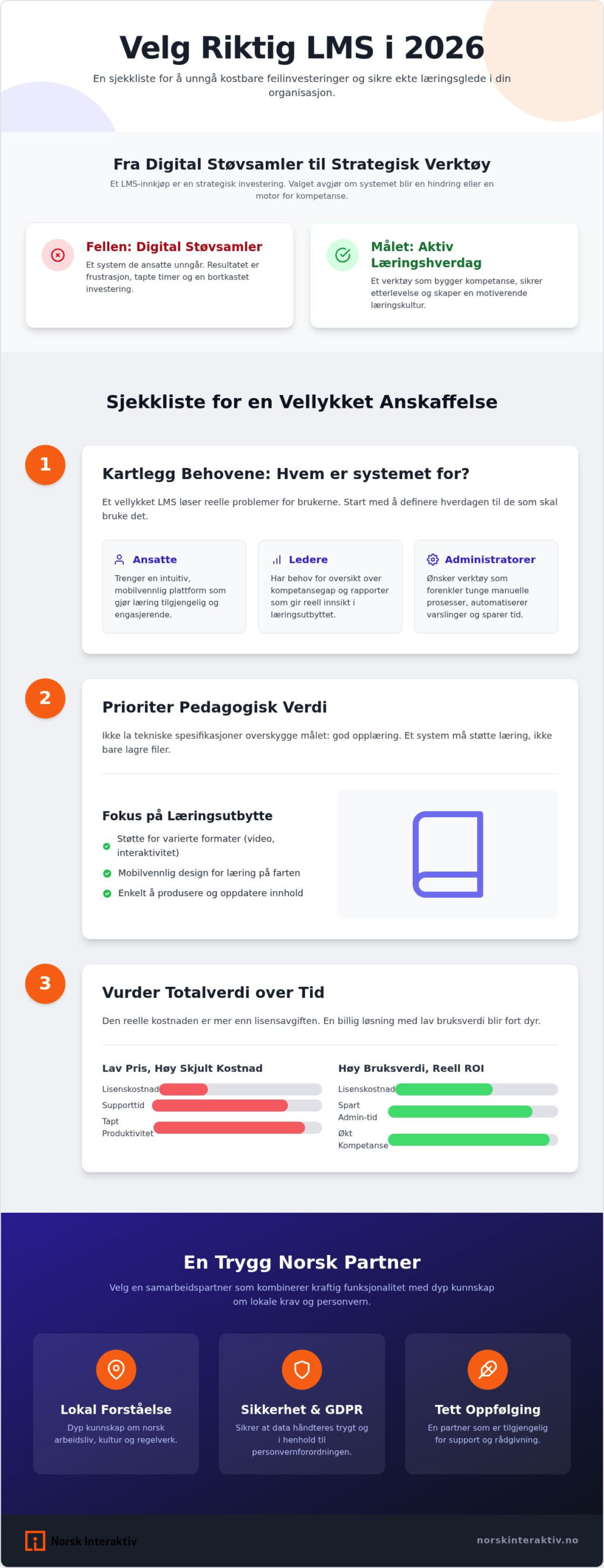
Many businesses fall into the trap of prioritising the lowest price over actual utility. It is of little help if the system is cheap if the threshold for logging in is so high that no-one uses it. Here are some critical points you should keep in mind:
- Total value over time: Assess how much time administrators save with a user-friendly solution compared to a complex system that requires constant support.
- User involvement Involve the end-users early in the process. If the staff experience the platform as a useful tool rather than a chore, the completion rate increases dramatically.
- Administrative simplicity: A good system must be intuitive to manage. If it is too complicated to roll out new courses, the content will quickly become outdated.
By having a conscious approach to these factors early in the procurement process for an LMS system, you lay the foundation for a learning platform that genuinely creates value and enthusiasm throughout the organisation.
Needs analysis: What does your learning platform actually need to solve?
Before you start comparing features or looking at pricing models, you need to define who the system is for. A successful LMS procurement is about understanding the everyday reality of those who will use it. Employees need a platform that is intuitive and accessible. Managers need an overview of skills gaps, while administrators need tools that simplify heavy manual processes. If the system feels like a hindrance rather than a help, engagement will drop rapidly.
You should also clarify whether the goal is internal training for your own employees, or whether you are going to run courses for external partners and customers. This affects everything from login methods to how the content is structured. At the same time, it is wise to consider the balance between off-the-shelf courses for general topics and tailored e-learning for company-specific routines. A good platform must be scalable. It should work just as well for 50 employees today as for 500 employees in two years' time. Plan for growth from day one.
Functional requirements vs pedagogical needs
Many people fall into the trap of focusing too narrowly on technical integrations. Even though the technical side is important, the pedagogical aspect must take centre stage. You need reporting and statistics that actually provide insight into learning outcomes, rather than just a list of who has clicked through a course. In 2026, users will expect support for varied formats. Video, interactive modules and webinars should be able to be combined seamlessly. Since many employees learn on the go, it is absolutely crucial that you choose a mobile-friendly learning platform that works just as well on a phone as on a PC.
Administration and content production
How easy is it to keep the content up to date? This point is often underestimated. If every tiny change requires external help, the system quickly becomes a bottleneck. By using tools like MentorKit Course Creator, you can build and adjust courses yourselves without deep technical expertise. This ensures that the information is always fresh and relevant for employees. Furthermore, the system must handle certifications and automatically send out alerts before competencies expire. This is especially important in industries with strict requirements for documented training.
It is all about finding the right balance between powerful functionality and ease of use. If you are unsure which direction suits your organisation best, it can be useful to look into the possibilities of a tailored learning platform for your needs that can grow alongside you.
Technical specification: Security, integrations and GDPR
Once the educational goals have been set, the technical foundation must support your ambitions. A modern procurement of an LMS system in 2026 is largely about choosing a cloud-based solution. This is now the industry standard because it ensures seamless updates, high availability and lower internal operating costs. Security is at the top of the agenda. With the introduction of the EU AI Act and stricter data governance requirements, you must ensure that the platform handles personal data with the utmost care. The Norwegian Data Protection Authority's service «Safer digital learning», launched in June 2026, is an excellent tool for assessing whether the supplier makes the grade.
Integrations are key to an efficient working day. To ensure administration runs smoothly, the system should talk directly to the company's HR solutions. This automates user management: when a new employee is registered in the HR system, they automatically get access to the correct courses in the learning platform. Single Sign-On (SSO) via, for example, Active Directory is an absolute requirement. It removes the frustration of forgotten passwords and minimises friction for the employees. Also remember to verify support for SCORM 1.2 and 2004. Even though new standards such as cmi5 are gaining ground, SCORM is still the backbone for reusing course content across different platforms.
Why choose a Norwegian LMS vendor?
Many discover too late that a global giant does not always understand local nuances. By choosing a Norwegian partner, you gain access to support in your native tongue and an adviser who knows Norwegian working conditions inside out. This is especially important when it comes to compliance with Norwegian requirements for HSE and privacy. A local player often has data centres located in regions that make GDPR work simpler and more transparent for your IT department. That provides a peace of mind that is hard to put a price on until a crisis arises.
User experience and accessibility
Technical quality is also about inclusion. In Norway, universal design is a statutory requirement for digital solutions. This means that the learning platform must be accessible to all employees, regardless of functional ability. A good platform uses interactivity as a tool to increase engagement, rather than just as decoration. When the system is easy to log into and works flawlessly across all devices, you make it possible for learning to actually take place in the small pockets of a busy working day. A successful procurement of an LMS system ensures that the technology works with you, not against you.
Checklist for the procurement process itself
Embarking on the procurement of an LMS is a journey that requires structure and clear leadership. It is not enough simply to watch a glossy demo and hope for the best. You need a process that ensures every part of the organisation is heard. Start by putting together a cross-functional project team. HR holds the pedagogical goals, whilst IT must approve security and integration possibilities. Operations represent those who will actually navigate the system every day. By involving these roles early on, you build ownership and reduce the risk of resistance when the system is later rolled out.
The preparation of a structured requirements document is the next step. Here, you should clearly distinguish between «must-haves» and «should-haves». Do not just list technical features, but describe concrete work processes. When you invite vendors to a meeting, you should ask for tailored demos based on your own user cases. What does a typical onboarding process look like for a new employee with you? How does the system handle your specific needs for recertification within HSE? After the demos, the best candidates should go through a piloting phase. Let a selected group of employees test the platform for a period. Their honest feedback on usability is often worth more than a hundred pages of technical documentation.
Assessment of the supplier's competence
Assessing the supplier's expertise is about more than just today's product. Check references thoroughly, and ask specifically about how the implementation phase worked for other companies in your industry. It is also wise to look at the supplier's roadmap for the future. In a world where technology changes rapidly, you want a partner that invests in continuous development and new learning methods. Assess the support system carefully. Are they available by phone and email when you have critical questions, or do you have to wait days for an answer? Good training for your own administrators is the key to becoming self-reliant and confident in your day-to-day work.
Finance and contract formation
Finance and contracting require full transparency from both parties. Ensure that you understand the entire pricing structure before signing. This includes annual licences, as well as one-off costs for implementation, integrations and any extra support. A robust data processing agreement is absolutely essential to safeguard privacy and meet the requirements of the GDPR. Plan the implementation process with clear deadlines and milestones. A successful start requires that both you and the supplier agree on what is to be delivered and when, so that the organisation is ready for launch at the agreed time.
Are you ready to take the next step in your digital learning journey? To ensure that you choose the right tool for your unique needs, you can Create a dialogue about MentorKit LMS Pro today.
MentorKit LMS Pro: A trusted partner for your e-learning strategy
When the formal process of purchasing an LMS system is complete, the real job begins: creating value in everyday work. Many companies find that the transition from procurement to actual use is the most critical phase. At Norsk Interaktiv, we do not view ourselves merely as a software supplier, but as a long-term partner. We have been helping Norwegian businesses with digital learning since 1996. We use this experience to ensure that your new platform becomes not just a technical tool, but an engine for growth and mastery.
MentorKit LMS Pro has been developed to bridge the gap between technical requirements and pedagogical goals. We understand that success depends on the system being easy to use for all parties. Therefore, we have developed an implementation methodology that safely guides you through the start-up phase. We assist with everything from technical setup and integrations to administrator training. By choosing a solution where you can combine the platform itself with tailor-made e-learning from the same supplier, you ensure a clear, consistent thread throughout your organisation's competence development.
Complete control of competence
Daily life as a course administrator should be characterised by clarity, not chaos. MentorKit LMS Pro automates the heavy processes that previously stole valuable time. The system handles everything from registrations and automated reminders to the issuing of course certificates. You get full control over both digital courses and physical gatherings in one and the same solution. For managers, this means access to powerful reporting tools that provide real-time insight into the organisation's competency level. If you want to know more about how this works in practice, you can read our guide on course administration system.
A forward-thinking solution that grows with you
Needs in 2026 are changing rapidly. That is why MentorKit LMS Pro is built to be scalable and flexible. With MentorKit Course Creator, you can easily produce your own content when new routines or products are to be launched. Do you need a quicker start? We also offer a wide selection of ready-made off-the-shelf courses on relevant topics. What truly provides peace of mind is access to our experienced Norwegian professional environment. We are here to provide advice on everything from pedagogical structure to technical optimisation. You get a partner who knows Norwegian laws and privacy requirements inside out. Purchasing an LMS system with us is an investment in a solution that will be just as modern tomorrow as it is today.
Training should be easy to succeed with. We help you create a learning culture that employees actually want to be a part of.
Ready to transform your company's learning culture?
A successful procurement of an LMS involves looking beyond technical specifications and finding a solution that genuinely excites employees. By thoroughly mapping needs, involving the right people and ensuring that data privacy is safeguarded, you lay the foundations for forward-looking skills development in 2026. It is about choosing a tool that supports the company's goals and makes everyday life easier for both managers and course participants.
Norsk Interaktiv has over 25 years of experience in developing digital learning solutions tailored to Norwegian conditions. Our Norwegian-developed software is built with an uncompromising focus on security and GDPR. This provides you with the peace of mind needed to succeed with digital transformation without worrying about technical or legal pitfalls. We are ready to be your mentor and partner throughout the entire process to ensure that you achieve your goals.
Order a no-obligation demo of MentorKit LMS Pro here to see how we can simplify your course administration and create a genuine joy of learning.
The road to a more efficient and inspiring everyday learning experience starts with a secure choice and a good partner. We look forward to helping you strengthen your company's overall competence and create lasting results.
Frequently asked questions about purchasing an LMS system
What does it cost to buy an LMS system for a medium-sized business?
The price of a learning platform depends on the number of users, the desired functionality and the need for integrations. Usually, costs consist of a setup fee and an ongoing licence fee. It is more important to look at the total value and time saved in administration than just the price tag. We always recommend an initial consultation to understand your unique needs before providing a concrete price quote that reflects the actual value the solution will add to your organisation.
How long does it take to implement MentorKit LMS Pro?
Implementation time varies based on complexity, but a standard setup often takes between four and eight weeks. We follow a proven methodology to ensure a smooth transition. This includes technical configuration, administrator training and any necessary migration of existing content. A clear project plan with fixed milestones ensures that together we reach the launch date in an efficient manner. We are closely involved throughout the process to ensure that everything works as agreed.
Can we integrate the LMS system with our existing HR system?
Yes, MentorKit LMS Pro is built to speak seamlessly with most modern HR systems and Active Directory (SSO). This automation is a central part of a successful procurement of an LMS because it removes manual sources of error. When an employee starts or leaves the company, access in the learning platform is updated automatically. This ensures that competence requirements and training logs are always correct without administrators needing to spend time on manual user updates across multiple systems.
What support do we get along the way in the procurement process?
Throughout the procurement process for an LMS system, you get a dedicated partner who guides you from the initial meeting to final rollout. We assist with needs analysis, technical specifications, and advice regarding pedagogical design. As an experienced Norwegian mentor, we ensure that you choose a solution that meets local requirements for GDPR and security. Our goal is to make the procurement safe and straightforward for your project team, so that you feel looked after in all phases.
Do we need technical expertise to administer the system?
No, you don't need deep technical expertise to manage the platform on a day-to-day basis. MentorKit LMS Pro is built with an intuitive interface for course administrators. We provide thorough training so that you feel confident building courses, managing users and pulling reports. For those who want to produce their own content, MentorKit Course Creator makes it easy to develop interactive modules with no coding required. We are always available for support if questions arise.
What is the difference between a cloud-based LMS and an on-premise installation?
A cloud-based LMS is hosted by the provider, ensuring automatic updates, high security and accessibility from all devices. By 2026, this is the standard for most businesses. An on-premises installation requires dedicated servers and internal IT maintenance. Cloud-based solutions are generally more cost-effective and scalable. It allows you to focus on the learning content itself and employee development, rather than spending resources on technical infrastructure, server management and complicated security updates that must be handled manually by your own IT department.
How do we ensure that staff actually use the new learning platform?
Success is about relevance and user-friendliness. Start by involving employees early and make sure the content solves their actual everyday challenges. A mobile-friendly platform makes learning accessible whenever it suits the individual. The use of interactive elements and clear learning paths also increases engagement. When the system feels like a useful tool rather than a chore, completion rates rise naturally. We would be happy to help you with tips on how to create a positive learning culture that lasts.
Do you offer ready-made courses that we can use straight away?
Yes, we offer a wide range of ready-made off-the-shelf courses covering common needs such as HSE, GDPR and management. These courses allow you to get started quickly while you work on more specialised content. You are free to combine these with bespoke e-learning or your own productions created in the MentorKit Course Creator. This gives you a complete and relevant learning library from day one, ensuring that the investment delivers value to the organisation immediately after implementation is completed.
 English
  Norwegian